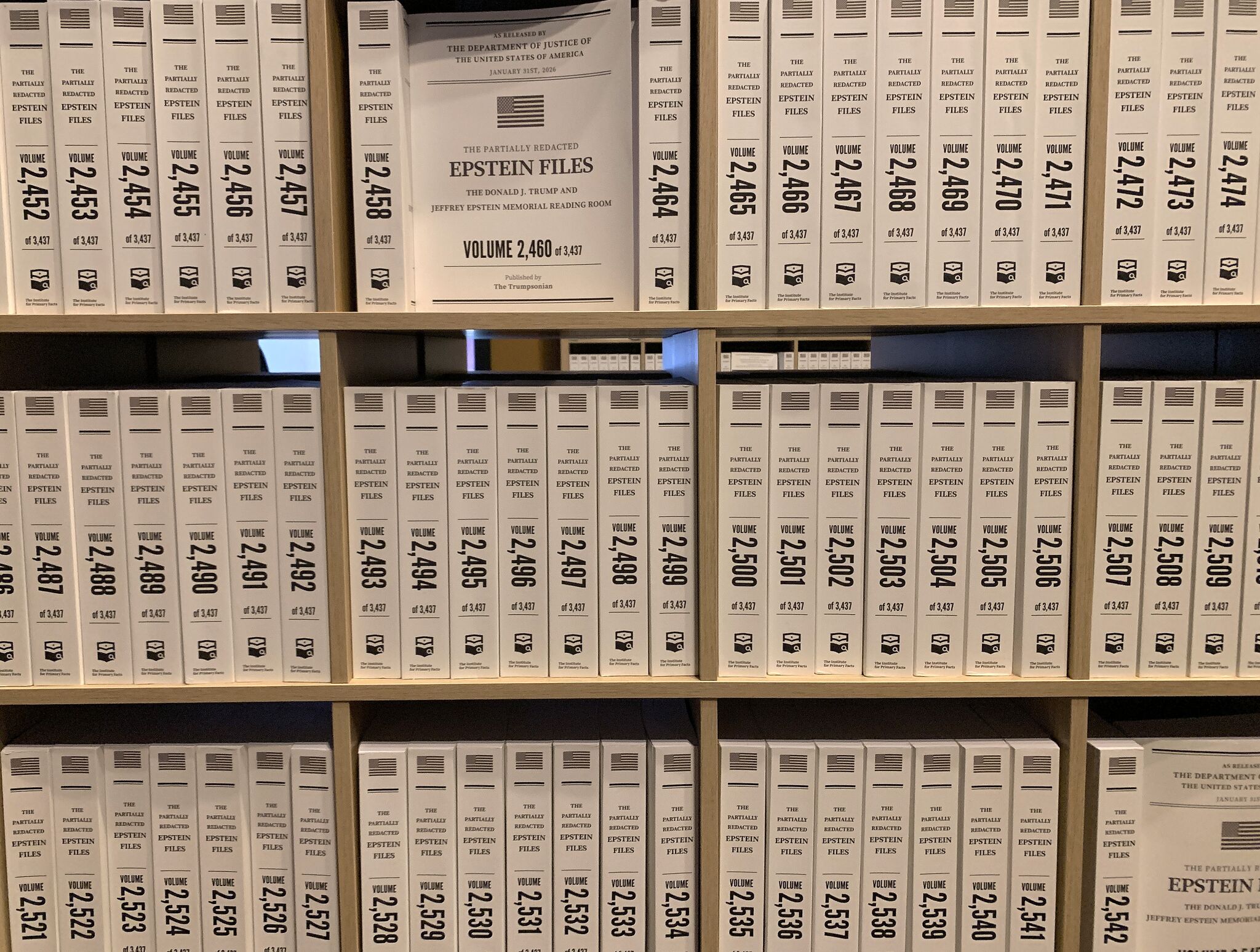
The Donald J. Trump and Jeffrey Epstein Memorial Reading Roomsits, for now anduntil Friday night, 12 miles away from the American Airlines Center, in a North Dallas event space off Midway Road near LBJ Freeway normally reserved for weddings, corporate events and bar and bat mitzvahs. I’d expected this physical manifestation of millions of pages heretofore available only digitally — bound in nearly 3,500 volumes, each two inches thick — would have been stationed closer tothe doings downtown.
But as I would be reminded time and again Wednesday morning, this traveling exhibition of emails; pastels and charcoals by Maria Farmer, an artist andEpstein accuser; and walls full of comment cards is not intended as protest art. Rather, it’s intended to serve as a visceral reminder that justice has so far been denied the more than 1,200 women who survived, and those who did not, years of sex trafficking and abuse.
The exhibition — theexperience —is intended to gut-punch the visitor. Because no matter how many times you might have searchedthe DOJ’s Epstein filesorthe Jmail website, there is nothing so powerful as being confronted by a seemingly endless, yet still incomplete, sprawl of grotesque villainy.
And as David Garrett, one of the exhibition’s organizers told me, “This was planned long before the Republican event” at the AAC, headlined both nights by President Trump. “They came all the way to us.”
Advertisement
Article continues below this ad
Dallas is just the third city in which the reading room has been assembled, after stints in New York City and Washington, D.C. I asked Garrett why here.
Gina Hinojosa, the Democratic nominee for Texas governor, listened Wednesday as Epstein survivors Sharlene Rochard, left, and Lara Blume McGee shared their stories.
“Because in New York and D.C., we talked to a lot of lawmakers, and we realized we need to go above their paygrade,” said Garrett, a Michigan man who,asThe New York Timespreviously reported, once sold high-end wines. He co-founded the nonprofit Institute for Primary Facts, which is behind the reading room.
“We needed to take this to their constituents,” Garrett said. “If we can’t make progress with the politicians, we need to talk to their bosses. The conversation is happening in Texas, so we came to Texas. We will go wherever we can appeal to voters.”
Advertisement
Article continues below this ad
The reading room opened to the public Wednesday morning at 10 a.m., when there were a few cars in the parking lot and a Dallas police officer at the door. Upon arrival you’re asked for your reservation code and a driver’s license (you must be older than 16 to enter), then given a brief overview of the exhibition, which begins with an enormous, museum-sized timeline documenting Trump and Epstein’s relationship, as well as the allegations made against both men.
Classical music softly spilled from the overhead speakers as about a dozen men and women slowly read every word. Among them was state Sen. Sarah Eckhardt, the Democratic candidate for Texas comptroller running against Don Huffines. Eckhardt reminded me thatHuffines owns what was formerly Epstein’s Zorro Ranch in New Mexico. The ranch, and what happened there during Epstein’s ownership, isthe subject of an ongoing investigation by the New Mexico Department of Justice. The Huffines family purchased the property four years after Epstein's death and is not connected to the investigation or Epstein.
Around the corner from the timeline is a door leading to the reading room — a short maze of shelves and shelves of bound books titledThe Partially Redacted Epstein Files, numbered to 3,437, so many that the volumes are spread, too, across a few library carts. Visitors are asked not to touch the books “out of respect for the survivors, whose names are not redacted.”