Share article
Print article
The media exposes a scandal – a network of rich, powerful men are abusing teenage girls. Outrage spreads fast and the public demands that authorities reveal the evidence and bring the perpetrators to justice. Yet the system shields many of those involved, and few face serious consequences. This isn’t about Jeffrey Epstein – it’s a scandal that unfolded in Victorian London.
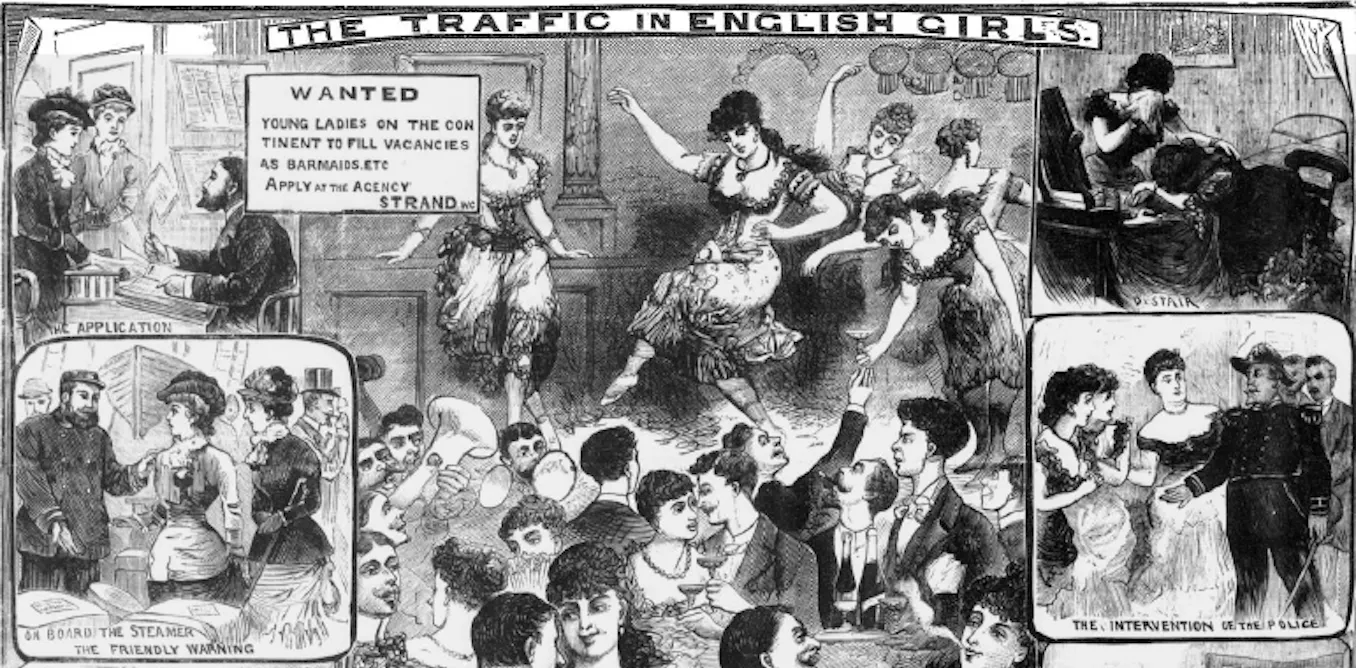
Our researchfocuses on thewomen and girlsat the centre of those events. In July 1885, a series of newspaper articles ran in the Pall Mall Gazette with the headlineThe Maiden Tribute of Modern Babylon. They exposedsystematic abuseandtraffickingof young girls. From the day the articles were published, there was uproar. Parliament was inundated with petitions and there was a huge demonstration in Hyde Park.
MPs were forced to respond, passing legislation which raised the age at which girls could consent to sexual intercourse from 13 to 16. Records of those events are held in the Women’s Library at London School of Economics, and some are displayed in its current exhibition,The Women’s Library at 100.
Read more:Victims have told us the worst of Epstein’s crimes for decades – and they are still being ignored
The Maiden Tribute was the final step in years of campaigning for a higher age of consent. Before then, legislation which aimed to raise it had languished in parliament. According to rumours among campaigners and politicians, this was because some MPs were guilty themselves of abusing young girls. Indeed, opponents openly argued that such legislation would expose their own sons to the risk of prosecution.
Frustrated activists had turned to W.T. Stead, the editor of the Pall Mall Gazette. Feminist campaigner Josephine Butler, leading Salvation Army members and Stead undertook an investigation of child sexual exploitation, visiting everywhere from brothels to rescue homes. Stead even “purchased” a 13-year-old girl named Eliza Armstrong and sent her to France (in the Salvation Army’s care) to prove that such procuring and trafficking was possible.
Butler notedin a letter to a friend: “O! What horrors we have seen!”
The resulting articles took the reader through the process of recruiting and abusing young women. They portrayed a whole industry devoted to the exploitation of the girls: procurers and brothel-keepers, doctors who “certified” virginity and midwives who ministered to their wounds afterwards.
The series was swiftly syndicated around the world as “the London scandal” and people speculated on the identities of the men described. In New York, it was rumoured that many prominent American men visited the notorious brothel madam Mrs Jeffries’ houses. Some of her clients were named in the campaigning newspaper The Sentinel as MPs, Lords and Dukes, the Prince of Wales and King Leopold II of Belgium.
Popular outrage forced MPs to pass the Criminal Law Amendment Act by August. As well as raising the age of consent for girls, the legislation rushed to introduce new offences of procurement and brothel keeping.
Some of these offences further criminalised women rather than those exploiting them. For example, if two or more sex workers operated in shared premises for safety, they could become liable for brothel-keeping – that is still the law today. A late amendment introduced by Henry Labouchere MP also outlawed allconsensual sexual activity between men; the new offence was used to convict the writer Oscar Wilde a decade later.
Ironically, only Stead and several of his colleagues were convicted as a result of these events. They were imprisoned for the kidnapping of Eliza Armstrong. Meanwhile, the men accused by campaigners of exploiting underage girls were unprosecuted and unpunished.
Read more:Oscar Wilde’s The Ballad of Reading Gaol is a work of art activism beloved by Banksy