On a Friday morning in May 2019, months afterDeutsche Bankclaimed to have severed its relationship with Jeffrey Epstein and just weeks before he was arrested, one of the financier’s longtime bankers sat at his desk in Deutsche Bank’s midtown Manhattan headquarters, scrolling through the bank’s internal systems. The numbers on his screen didn’t match the story his institution had begun telling the outside world.“Since the client intends to have the rest of their accounts closed this week or next, let’s agree on what is still open,” Stewart Oldfield, then a director in Deutsche Bank’s U.S. wealth unit, wrote to colleagues on May 10, under the subject line, “Epstein account closure.” He added a line that showed the bank had still not made a clean break with Epstein: “I think some of the accounts are zero balance but still open.” Oldfield’s messages were contained in the cache of 3 million files on Epstein released by the U.S. Department of Justice.Oldfield didn’t respond to repeatedFortunerequests for comment.Five months earlier, in December 2018, Deutsche Bank had formally told Epstein it was ending the relationship. Senior wealth executives weighed the reputational damage of continuing to work with a convicted sex offender against the revenue he generated. Oldfieldreportedly told the bankthat Epstein brought in more than $1 million a year in fees and trading income, a figure consistent with earlier internal estimates that had pitched his potential value at $2 million to $4 million annually, according to theFinancial Times. In the end, the reputational risk case prevailed. The bank claimed in a consent order with the New York Department of Financial Services to have sent Epstein a termination letter on Dec. 21, 2018, that said the relationship had to end. Epstein’s team, according to theFinancial Times, was given until the end of February 2019 tomove his moneyelsewhere. But the day before the original deadline, internal emails reviewed byFortuneshow, his associates were then given their first of many extensions.The termination letter became a pivot point: In regulatory filings from 2020 and in other public statements, Deutsche Bank described the relationship as running from August 2013 to December 2018. Internally, the reality was much messier. As the February deadline approached, Epstein’s entities had not finished leaving the bank. Oldfield agreed to allow accounts to remain open beyond the original cut‑off, buying time for transfers and telling colleagues that he needed to coordinate what was “still open” on the bank’s internal platforms.Meanwhile, some of Epstein’s accounts officially remained open at the bank following his arrest on July 6, 2019—seven months after he was supposed to have been terminated. It wasn’t until July 9, 2019, that all of Epstein’s accounts were closed at the bank.
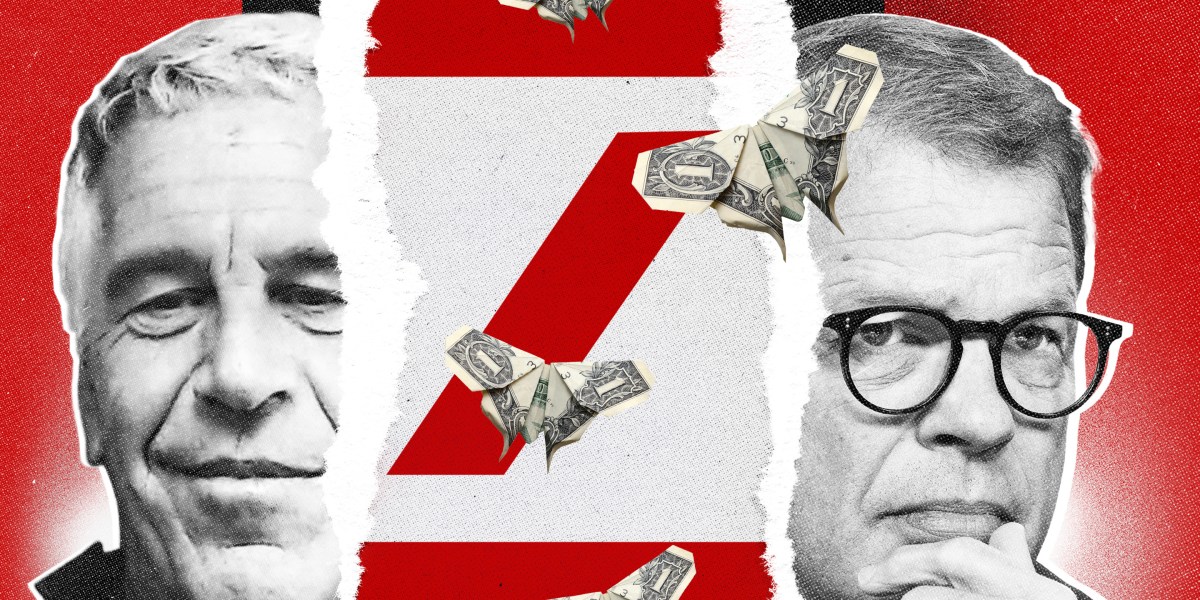
Internal communications, trading confirmations, and cash‑handling emails released by the DOJ show Epstein’s money still pulsing through the bank’s systems well into 2019; his aides still getting concierge‑level service on six‑figure cash pickups; and his banker, Oldfield, still treating him as an A-List client in the lead-up to his arrest.Perhaps most seriously in terms of Epstein’s victims—the women and girls he raped and trafficked—Deutsche maintained a special account for Epstein until it was emptied May 2019 and closed two months later. It was named “The Butterfly Trust,” according to a presentation by the Southern District of New York and DOJ files, and it was used to make nearly $3 million in payments to “alleged co‑conspirators or women with Eastern European surnames, for the stated purpose of covering hotel expenses, tuition, and rent,” according to documents filed with New York state. And, as emails reviewed byFortuneshow, Deutsche staff who asked questions about who these women were, and why they received such large amounts of cash, were repeatedly brushed off by Epstein’s client-handlers at the bank. The account was one of two still open days after Epstein’s 2019 arrest.
The files reviewed byFortune—internal trade confirmations, email chains, and newly detailed financial accounts from Epstein’s in‑house trader Paul Barrett—call into question the story Deutsche Bank and New York regulators agreed to in 2020: that a high‑risk client onboarded in 2013 despite his 2008 sex‑crime conviction was monitored badly and finally terminated in December 2018 after a fresh wave of negative press.
Instead, the records show a bank that welcomed a convicted sex offender with open arms—giving him access to senior executives, tailored trading lines, and bespoke structured products—and then took months to fully close the door even after the risks became impossible to ignore.
“As we said in 2020, we acknowledge our error of onboarding Epstein in 2013 and the weaknesses in our processes, and have learnt from our mistakes and shortcomings. Immediately following Epstein’s arrest, we contacted law enforcement and offered our full assistance with their investigation. We have been fully transparent and have addressed these matters with our regulators, adjusted our risk tolerance and systematically tackled the issues,” a spokesperson for Deutsche Bank toldFortune. “We have invested significant sums in training, controls and operational processes, and have increased our anti-financial crime team. We have repeatedly stated that we deeply regret our association with Epstein.”
The spokesperson emphasized that the bank “notified Epstein in December 2018 that the bank intended to close his accounts. The bank worked to ensure that Epstein’s assets were transferred out of the bank in the following months.”
According to an internal bank source, by May 2019 (three months after the original deadline given to Epstein), his accounts were drawn down to zero or nominal interest balances, while certain accounts allegedly required manual closure.
The gap between the timeline Deutsche Bank gave its regulator, which appears to be inaccurate, and the timeline the documents describe is where potential legal exposure for the bank begins. The consent order was signed for the bank by its various general counsel staff and heads of litigation—senior lawyers who attested that its factual claims were accurate.
“Anytime you affirm something, you’re basically saying, I swear this is the truth,” Priya Chaudhry, a high-profile white-collar criminal defense lawyer, toldFortune. “Once you submit something like that, you can be prosecuted for making false statements.” Chaudhry drew a line between two kinds of inaccuracy. “Incorrect is, you make a mistake. False is when you know that you’re either saying something that isn’t true in a material way, or you’re omitting something on purpose so that you deceive,” she explained.
The relevance for a corporation, she said, runs through the people who sign. “Whenever you have a corporation, like a bank, it’s a thing. It can only act through people. And so then the question is, is the person who’s making the affirmation aware of whether or not that is accurate? In something like this, those people have a duty to become knowledgeable about it. They can’t put their head in the sand.”
“In something like this, those people have a duty to become knowledgeable about it. They can’t put their head in the sand.”
That duty matters because the relevant New York statutes don’t require affirmations to be in a public court filing or a press release.
Under New York state statute section 175.10, “falsifying business records in the first degree” is a felony. Under that law, intent has only to include the aim of concealing another offense.
A separate statute, “offering a false instrument for filing, ”under section 175.35, prohibits offering a document containing false information to a public agency. It is also a felony.
And section 175.05, “falsifying business recordsin the second degree,” an internal record alters the legal calculus the moment “the intent to defraud” attaches. Breaking this law is a misdemeanor.