A New York exhibit of more than 3,000 volumes bills itself as ‘an exercise in radical transparency’ – and a bid for attention
This February, a story broke that seemed like it might finally bethe one. Reporters at NPR hadnoticedthat there were pages missing from the enormous tranche of Epstein files released by the Department of Justice. Further reportingrevealedthat the files in question were 2019 FBI interviews with a woman who claimed to have been sexually abused byJeffrey EpsteinandDonald Trumpwhen she was a minor. The justice department had no good explanation for why the documents had been withheld. Trump issued blanket denials.
It was all starting to feel like a good old-fashioned something-gate, the kind of scandal that might even bring down a presidency. But then, as with so many other stories in the era of Trump, its spark was subsumed by a new fire. On 28 February, Trump launched an unprovoked and likelyillegalwar against Iran, and the Epstein files were once again pushed off the front pages.
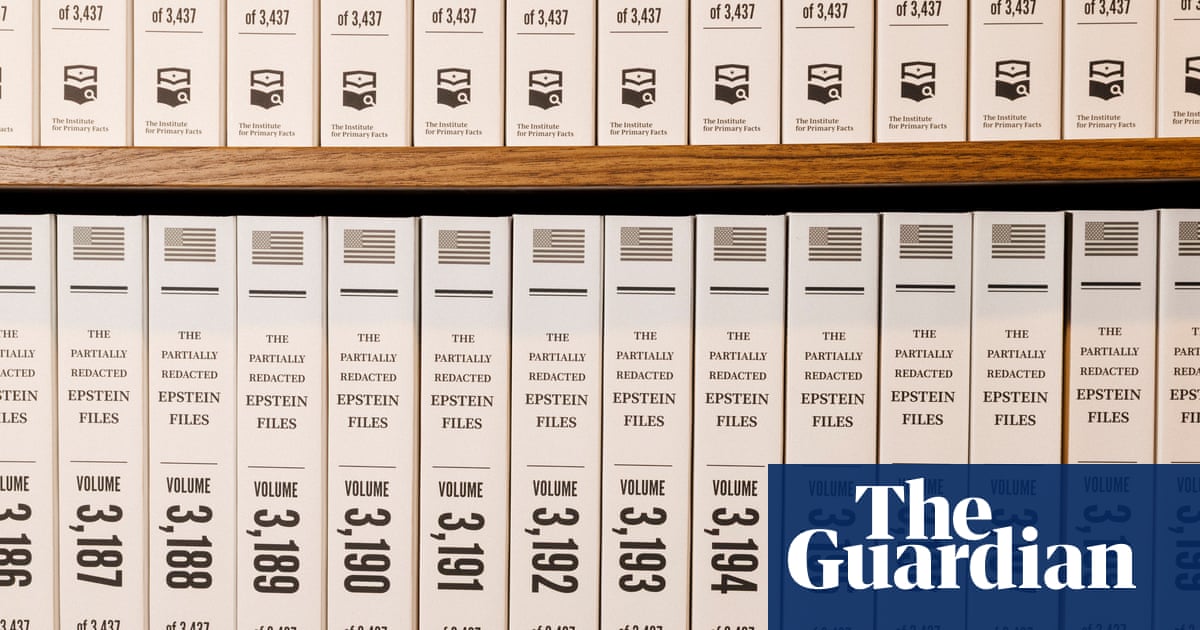
TheDonald J Trump and Jeffrey Epstein Memorial Reading Roomis an attempt to stem the dreadful tide of ephemerality that is our Trump-addled news cycle. A project from the not-for-profit groupthe Institute for Primary Facts, the pop-up exhibit has transformed a storefront gallery in New York’s Tribeca neighborhood into an IRL library of the Epstein files. Which is to say, the group took thedigital filesreleased thus far by the government, printed them all out in the order they were released, and bound them into 3,437 volumes. The two rooms of the gallery are lined with bookshelves floor to ceiling, and the overall effect is one of overwhelm. This is what 3.5m pages of investigative files actually look like – and it’s a lot.
“If you are doomscrolling on your phone, you see a cat video, and an ICE raid video, and your aunt’s birthday cake, and evidence of one of the most horrific crimes in American history – it’s all just together on your phone. One thing is as important or unimportant as the other,” said David Garrett, one of the primary organizers behind the project. “Having a physical space really gives people the ability to see context.”
The reading room bills itself as “an exercise in radical transparency” and is free and open to the public through 21 May, though visitors must make an appointment and most are not allowed to actually peruse the documents due to concerns by survivors that the governmentfailed to redacttheir personal information. (The Institute for Primary Facts is raising money to mount the exhibit in other cities.) It also features a timeline of allegations of sexual misconduct against Trump and Epstein, as well as of their relationship with each other, which the US president has long tried to downplay. Notecards are provided for visitors to record their reflections. In the center of the main room, 1,400 artificial candles are displayed behind semi-sheer curtains, a tribute toEpstein’s victims. (The justice departmenttold Congressin December that it had redacted the names of 1,200 people in the files “identified as victims or their relatives”; Garrett said the group chose 1,400 to account for victims who may not have come forward yet.)
“When you look at that and each one of those is a life, you’re like, ‘How is it that he wasn’t stopped after 10 or 20 or 200 or 500 or 1,000?’’” Garrett said of the candles. “It means something when you see that – that’s hard to get on your phone.”
As an exercise in demonstrating the scale of two large numbers – 3.5m files, 1,400 candles – the project certainly succeeds. Standing in the gallery, I appreciated in a visceral sense the sheer weight of the evidence – the 5lb volumes come off the shelves with a bit of anoomph– and the vast number ofwomen and girls whose lives Epstein upended. One of those women, Virginia Giuffre, took her own life last April.
But I’m less certain that the project has anything much to say about the particular horror of the Epstein case: the devastatingly individual tales of vulnerability and abuse that were brought to life byjournalist Julie K Brownhave been smoothed over to produce what is, essentially, a troll of Trump. We know that Epstein cultivated relationships with intellectual, financial and political elites across the ideological spectrum; the project’s clickbaity focus on the president undermines a more holistic (and accurate) understanding of the networks of money and power that allowed Epstein to prey on women and girls with impunity.
The reading room looks like a library, but it has none of the utility of one, which is a shame. The Epstein files were released by the justice department with all the care of an ex emptying out a box of belongings on the sidewalk in a rainstorm. Rather than bringing sense and structure to the document dump, the reading room reproduces it.
“The fact that the files are bound especially seems foolish,” said Emma Best, an investigative journalist who spoke to the Guardian by Signal chat. Best is co-founder ofDistributed Denial of Secrets(DDoSecrets), a whistleblower site that publishes large leaks of public interest datasets, including thousands of Epstein’s emails prior to their release by the justice department. “It makes them less readable and much harder to update,” she added.
Volunteers have undertaken projectssuch asJMail.world, which transformed the justice department’s PDFs of Epstein’s email back into a recognizable (and searchable) email interface, andEpsteinExposed, a database and network graph built by a data engineer who got so frustrated with the lack of organization in the justice department release that hequit his jobto work on the project full-time. It’s tempting to imagine what the “low six-figures” cost of the reading room could have accomplished if it had been applied toward, say, a small team of librarians and archivists.
“Six figures would pay for a lot of research which could be used to identify people in the files and contextualize their presence,” said Best. “That much money would fund DDoSecrets for a year.”
Absent utility, what’s left is largely aesthetic: it bears the distinct whiff of the Museum of Ice Cream and other so-called “experiums” that are transparently designed to serve as a striking backdrop for Instagram posts. Indeed, Garrett said that the mostly anonymous team behind the project included late-night TV writers, people involved with the March for Our Lives and the Women’s March, and “people that had put together immersive experiences for Disney”. I don’t know that we need a Museum of Billionaire Sexual Exploitation, but if we get one, I would hope it has more to say about violence against women and elite impunity than this vaguely funereal bed of candles, its battery-powered lights flickering uncannily in sync.
Garrett said that he was inspired to found the Institute for Primary Facts when the Smithsonianremoved references to Trump’s two impeachmentsfrom a display at the National Museum of American History last year. “I got pissed off,” he said. “I texted everyone I knew, like, ‘I’m gonna raise money and I’m gonna do a thing.’” The website and public filings of the Institute for Primary Facts reveal little information about the group or its funders, but Garrett, a wine entrepreneur and self-described “lean startup guy”, said that he “wrote the first check”. The board is made up of Garrett, Democratic strategist Jenna Lowenstein and Mary Corcoran, co-founder of an “anti-Trump former Republican” Pac that plans to spend $100m opposing the Maga movement in the midterms.